How Search Engines Work and How to Optimize Your Content for Them in 2026
How exactly do search engines determine what users need, and what practical SEO (and GEO) tips for content marketers result from this? We’ll explore this step by step: from initial indexing to Perplexity.

1. Crawling and indexing
2. How Google determines which content appears at the top
3. SEO Content Strategy: How Do You Determine What Content You Need?
4. Technical and off-page SEO: performance and structure as the foundation
5. AI and other innovations
Crawling and indexing: how to make sure your content is findable?
How search engines discover and process content
New web pages are only indexed by search engines once a crawler detects them. Crawlers are search robots that scan the web for new or updated content. The pages they find are analyzed and stored in a search engine index: a massive database of web content. When you perform a search, the search engine matches your query to that previously created index.
Google uses about fifteen types of crawlers. It employs desktop and smartphone crawlers, and those mobile crawlers are becoming increasingly important.
When you create a new page, a Googlebot needs to discover it by crawling it. Well-known websites are regularly checked for updates. Therefore, always place links to new pages on authoritative pages of your website—preferably on the homepage.
Click depth
The way crawlers work affects the number of sublevels in your website's structure.
Ideally, a Googlebot should reach each page within a maximum of three clicks from your home page. Greater click depth slows down crawling and usually does not benefit the user experience.
How do you apply this?
- A logical site structure makes it easier for crawlers to find your content.
- Make sure your website is also pleasant to visit on mobile.
- Make smart use of internal links and feature news on your homepage.
- Choose a hub & spoke structure and use clear, content-rich urls.
- Use semantic HTML (tags that convey meaning as well as structure for different parts of a web page) to help Googlebots understand what your content is about.
Want to know more?
Check out Google’s own guide on crawling and indexing.
How Google determines which content ranks at the top
After pages are crawled and indexed, the search engine uses complex algorithms to determine which results come out on top for a search. Google uses hundreds of ranking factors that factor into the algorithm. But what are the major principles?
Relevant content
A page's content should be relevant to a particular search query.
That means, among other things, that the words and phrases the user searches for appear on your page. Synonyms and related terms also come into play. The algorithm also checks to see if your page really addresses the topic the searcher is referring to. The quality of your content and how directly you answer the query play a vital role.
E-E-A-T principle
Google evaluates content quality through the E-E-A-T principle, among others :
- Experience
- Expertise
- Authoritativeness
- Trustworthiness
Does the author have experience and expertise? Is the site an authoritative source, and is the content reliable? While this doesn’t directly contribute to your score, many factors that influence E-E-A-T are taken into account in your ranking (such as high-quality backlinks, author bios, and content depth).
In practical terms, this means: write valuable, original content that truly answers the search query. Comprehensiveness is key. A page that explains a topic from A to Z and addresses related questions has an edge, because Google considers such a page to be more valuable for users.
Quality and user behavior
Although Google is reluctant to discuss the role of user behavior in its algorithm, it is believed that it is at least monitored to evaluate search results.
What percentage of users in the search results click on your page? How long do those users stay on your page? A page that users immediately click away from to return to Google is considered less relevant for that search query.
Context, intent, images, and video
The Google algorithm is becoming increasingly adept at analyzing the context and underlying intent of a search query. AI models such as RankBrain (2015) and MUM (2021), which recognize and interpret patterns in content and search behavior, play a major role in this evolution. MUM is even capable of understanding content in multiple languages and making connections between different media types such as text, images, and video.
Search intent is the underlying reason why someone enters a search query into a search engine.
Google distinguishes four basic categories:
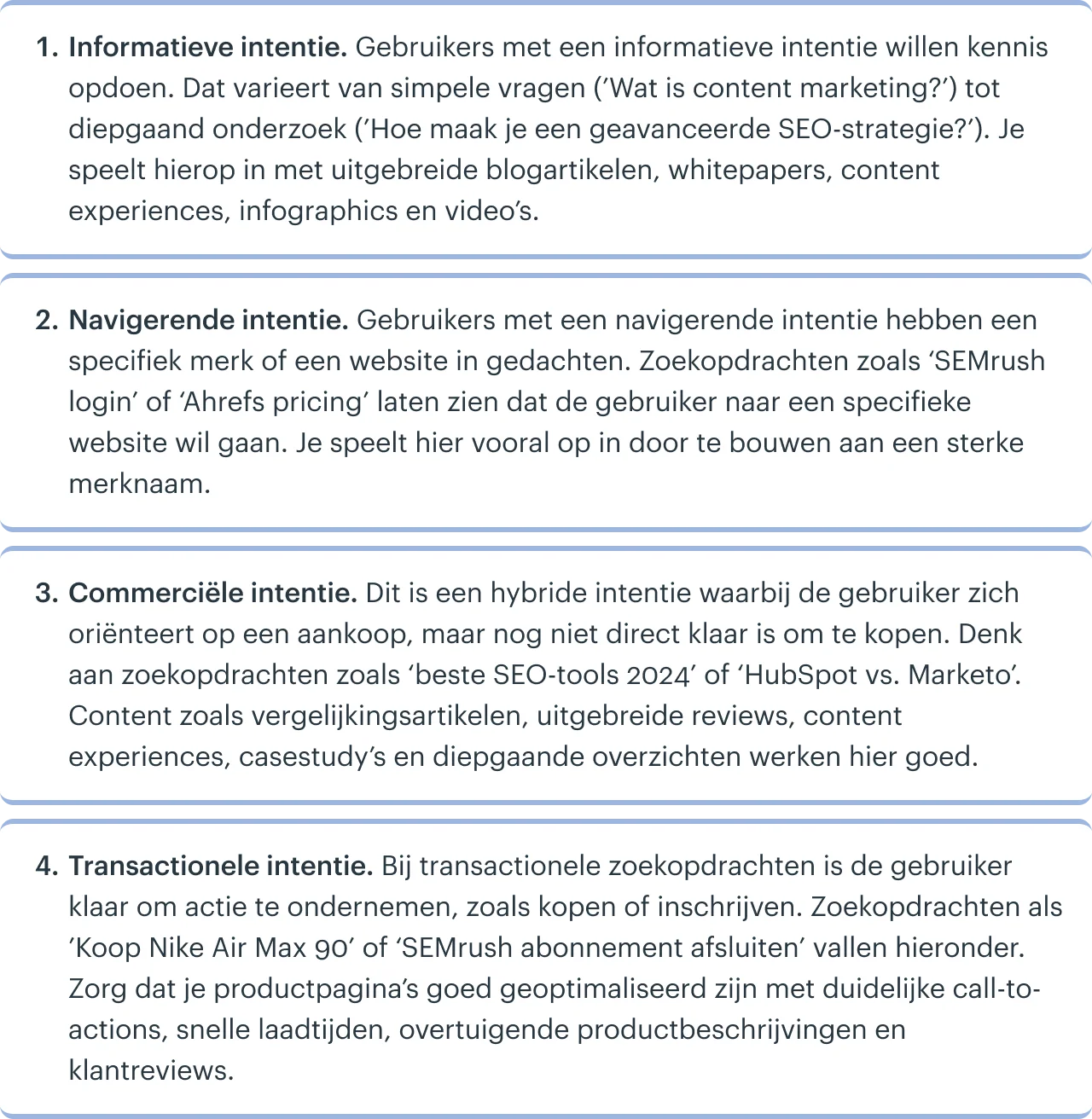
If the search intent is time-sensitive, the algorithm will prioritize more recent content because users want up-to-date information. If the query is timeless, pages that have established authority over time may rank higher.
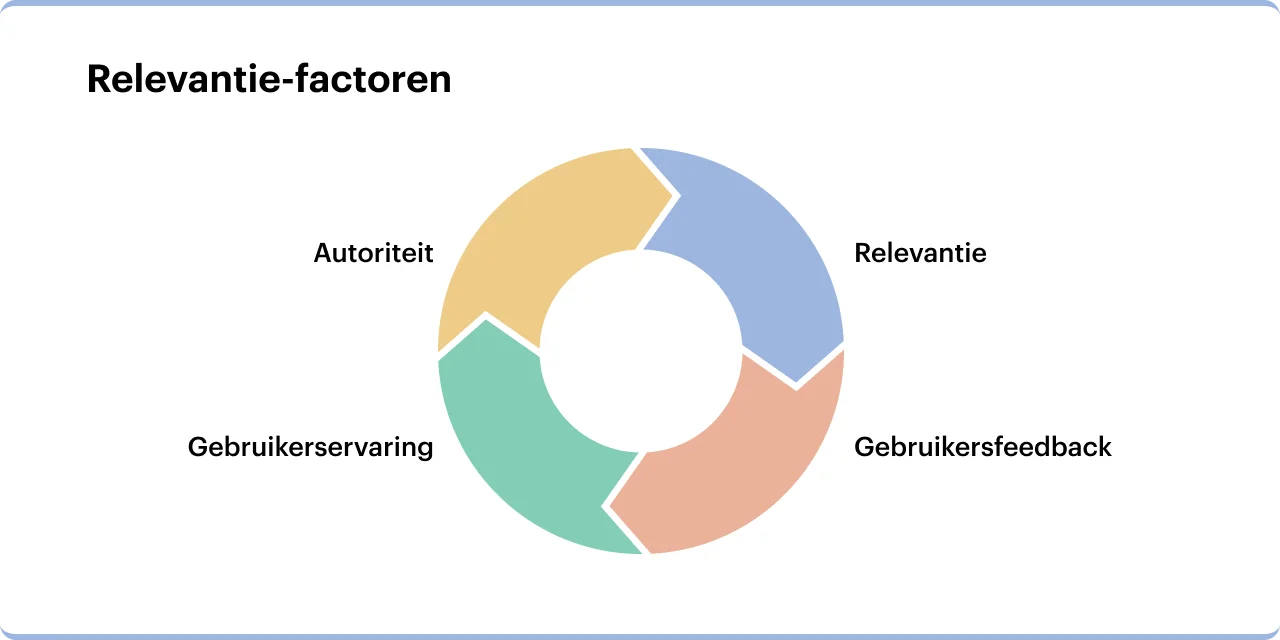
In summary, Google uses a combination of relevance factors (how well the content matches the query), authority factors (how much authority and backlinks the site has), user experience factors (technical aspects, speed, mobile optimization, etc.), and user feedback factors.
How do you apply this?
- Tailor your content as closely as possible to the user’s intent. Answerquestions directly and clearly, without any unnecessary fluff.
- Use natural language and synonyms. Artificial intelligence understands concepts and context, not just exact keywords.
- Invest in valuable, original B2B content that fully answers a search question and includes related questions.
- Target long-tail search queries. People are searching in increasingly specific terms and using natural language, especially with the rise of voice search.
- Be clear about the purpose of your page. On a transactional page, provide product benefits and an easy purchase path; on an informational page, bring entertaining or informative content.
- Showcase your experience and expertise. Add a bio or share specific details, case studies, and experiences. Focus on your unique B2B expertise—such as original research or interviews—to set yourself apart.
Want to know more?
Check out Google’s AI Blog on MUM and search intent.
SEO content strategy: how to determine what content you need?
The basic principle is this: put user needs first and use SEO techniques to maximize your content’s visibility. A good SEO content strategy combines creativity and data. You write for people, but with insights that help search engines.
Focus on value-added creation and optimization
A content strategy starts with understanding your target audience. What questions do they have about your product category, and what problems are they trying to solve? And how can your content help them? Use keyword research and tools like Google Keyword Planner to identify popular questions and search terms.
Look beyond individual keywords and identify topic clusters. For example, if you’re writing about “sustainable living,” your audience might search for everything from “energy-efficient home technologies” to “calculating solar panel output” and “insulation grants.”
Topic cluster strategy
Organize your ideas into a topic cluster strategy tailored to your target audience’s customer journey. This involves creating a single comprehensive pillar page on a broad core topic, with multiple subpages beneath it that cover specific aspects or related subtopics. The subpages all link back to the pillar page and often link to one another as well.
A cluster structure increases the chance that your pillar page will rank high on the broad topic as well as that the subpages will each rank highly for their specific search terms. In addition, it improves the user experience: you immediately offer further relevant reading options via internal links. Because you cover the entire customer journey, you create content that matches different intents (from information to transaction).
Want to know more?
Check out HubSpot’s guide to Topic Clusters: The Next Evolution of SEO
Technical and off page SEO: performance and structure as the foundation
Technical SEO lays the foundation for your content's success. While strong content and link building often get the most attention, a well-optimized website is just as essential for ensuring that search engines can crawl and understand your site properly.
Some technical checks
- A faster website doesn’t just mean happy users—it also increases your chances of achieving good search rankings. Optimize for speed and mobile. ****Make sure your CSS, JavaScript, and images are optimized (minified code, compressed images). Choose a fast hosting provider. Go for lazy loading: only load images when they come into view. Choose user-friendly buttons, and don’t include less content on your mobile site than on your desktop version, and so on.
- Google primarily uses your mobile site for indexing and ranking. Check Google Search Console to see if there are any errors in your Mobile Usability Report.
- Make sure your website has a clean robots.txt file (that doesn’t block any critical content), an up-to-date XML sitemap, proper canonical tags, and so on. Also, manage your HTTP status codes (404 pages with deleted content and 301 redirects) properly.
- Of course, make sure your site runs on HTTPS (with a valid security certificate).
- If you have multilingual or regional versions, implement hreflang tags so that Google shows the correct language/region version to the right users.
- Titel-tag en Meta-description. Zorg voor een unieke, beschrijvende <title> voor elke pagina (max 60 tekens) die het hoofdzoekwoord bevat en uitnodigt tot klikken. Bijvoorbeeld: ‘Hoe maak je lasagne? – Recept & stapsgewijze handleiding | Kookplatform’.De meta-description (155 tekens) moet de pagina samenvatten en een call-to-action bevatten. Hoewel meta-descripties geen rankingaandacht geven, verhogen goede meta’s je CTR (en daarmee indirect je succes).
- URL structure. URLs with clear, descriptive content that include the keyword perform better than those with unclear parameters. So it’s better to use ‘.../sustainable-living-tips’ rather than ‘.../article?id=111&cat=4’.
- Structured data. Use this format to generate rich results: special listings that appear at the top of search results and include additional information. Examples include FAQs with expandable questions directly in the search results list, events with dates and locations, etc.
Off-page SEO: backlinks and brand awareness
By off-page SEO, we refer to factors that lie outside your website, but which you can influence to some extent. Therefore, within this article, we will deal with them only very briefly.
A very important part of off-page SEO is link building: acquiring high-quality (back)links to your site. Backlinks are considered real ranking boosters: they give Google a strong indication of your authority.
The most effective way to build backlinks is to focus on content marketing. Create content that people want to share or link to. If you want to take it a step further, you can also start guest blogging. Or look for broken links on relevant topics on other sites and ask to have them replaced with your link.
Want to know more?
Check out this Semrush guide to rank higher with rich snippets in 2025
Other search methods: GEO, voice, and image search
Thanks to AI search engines and other search tools, the way people search today is broader and more diverse. This means you need to adopt an increasingly broad and in-depth approach to ensure maximum visibility.
Generative Engine Optimization (GEO)
Google remains by far the most widely used search engine. By the end of 2025, 78% of all digital searches were conducted on Google, 17% on ChatGPT, and 5% on other tools such as Bing and Perplexity. (Source: Firstpagesage Q4 2025)
AI tools like ChatGPT largely work in a similar way to Google, using crawlers, indexing, and ranking algorithms. A solid SEO strategy already lays a strong foundation for optimizing your content for tools like ChatGPT, Gemini, and Perplexity.
In addition, you'll build a GEO module that takes several factors into account.
In summary:
- Focus even more on the different contexts in which your personas search and on conversational search queries rather than on keywords.
- GEO enhances the impact of building a trustworthy brand and brand awareness (cf. E-E-A-T).
- Add some GEO-metrics, such as LLM traffic/landing page data, crawler logs, and prompt tracking, to your SEO dashboard.
- GEO creates compelling, scannable content that aligns with search intent, making an optimal user experience even more important.
- Compared to Google, AI tools more often source data from platforms such as Reddit, Wikipedia, YouTube, Facebook, and LinkedIn. If possible, strengthen your presence on those channels. (See the Semrush comparison study and Semrush’s most cited domains)
Voice and image search
Voice queries are on the rise in both Google and LLMs like ChatGPT. Capitalize on this trend by using longer keyword combinations and more conversational content. Think of FAQ pages and Q&A content. These longer combinations are also valuable for Google’s AI overview.
AI also makes visual searches more effective. With Google Lens, you point your camera at an object and Google finds information about it. Or you can combine a photo and text in your search query (“find shoes like these, but in blue”).
Make sure your image SEO is in order, with images that have good alt text and plenty of relevant images that Google can understand.
Video content also continues to grow and may become even more important thanks to AI, since AI chatbots can process videos fairly easily.
Consistency and timeliness
Just like Google’s algorithm, AI tools are changing rapidly. They are also less consistent than Google in terms of their output and the sources they use. It is striking that user-generated content, such as Reddit, plays a more significant role.
Anyone who is already well ranks in Bing also has an edge in ChatGPT, which largely uses Bing’s search infrastructure and indexing system. (See Semrush’s overview of Bing and Google’s ranking factors.)
In addition, Perplexity is based on a smaller index that is updated daily, which means it places a higher value on current information.
But aside from those minor differences, anyone who wants to rank well in AI search engines is best off following the same approach that Google recommends:
- Focus on the quality of your content and build your authority.
- Create quickly scannable content with a logical structure.
- Create content that aligns as closely as possible with the user's search intent.
Want to know more?
Check out this annual overview from the agency First Page Sage on how much weight the various factors carry in the current Google algorithm.
FAQ: SEO in 2026
1. What is the most important SEO trend in 2026?
The biggest SEO trend is that smart algorithms are causing SEO optimization to become increasingly broad and content-driven. Those who want to make a difference must focus on quality, authority, search intent and content relevance. Structured data and image and voice search are also becoming more important.
2. How do I get my content crawled and indexed quickly?
Place internal links to new pages on your homepage. Make sure your site has a logical structure and that Googlebot can reach each page within three clicks. Use an XML sitemap and check your robots.txt file.
3. What factors determine whether my content ranks high in Google?
Google is looking at a combination of:
- Relevance (does the content match the search query?)
- Authority (how many quality backlinks does the page have?)
- User experience (loading speed, mobile-friendliness, internal link structure)
- User signals (click rate, time on page, bounce rate)
4. What is E-E-A-T and why is it important?
E-E-A-T stands for Experience, Expertise, Authoritativeness and Trustworthiness. Google uses that principle to assess the reliability and quality of content. Provide well-researched content, clear author attribution and quality backlinks to improve your E-E-A-T.
5. How do I optimize my content for search intent?
Tune your content to the four main categories of search intent:
- Informative: Offer in-depth, educational content such as guides and blogs.
- Navigating: Make sure your brand and product names are clearly present.
- Commercial: Create comparison articles, reviews and case studies.
- Transactional: Optimize product and landing pages with clear CTAs.
6. What is a topic cluster and why is it useful?
A topic cluster consists of a pillar page (main article on a broad topic) and multiple subpages that cover specific subtopics. This structure helps search engines understand the structure of your content and increases your ranking chances on broad as well as specific search terms.
7. How important will technical SEO still be in 2026?
Technical SEO remains a foundation for good rankings. Important aspects are:
- Speed: optimize images, minimize code and use fast hosting.
- Mobile-friendliness: Google primarily indexes the mobile version of your site.
- Structured data: helps Google generate rich results.
- Indexing: make sure Googlebot can crawl and process your pages properly.


